How Does Santa Claus Get Into A House Without A Chimney
No Chimney? Not to worry, Santa Is Still Coming
You better watch out
You better not cry
Better not pout
I’m telling you why
Santa Claus is coming to town!
Yes, that’s right everyone…the countdown to the arrival of Santa Claus is winding down which means that now, more than ever, we must be on our absolute BEST behavior!
As you deck you halls and hang your mistletoe, you may be part of the 60% of homeowners without a fireplace wondering just how exactly Santa will be stopping in to drop of your presents.
“Only 40.3% of homes in the U.S. have fireplaces, according to the Hearth, Patio & Barbecue Association, meaning Mr. Claus must find an alternative entry into about 60% of homes on Christmas Eve.” (WSJ)
At Coldwell Banker, we believe in the magic of home, especially around the holidays. We just HAD to find out the answer to this age old question. To find out we went straight to our source in the North Pole, CeeBee the Elf, and asked “How Does Santa Claus Get Into a Home Without a Chimney?” and got the inside scoop.
The answer is simple… magic and a key!
Santa’s Magic Key Poem
Dear Santa, we have no chimney
as you can plainly see,
And I was terribly worried
that you would pass over me.
We hung this very special key
right by the door.
Then Mom told me to jump into bed;
and not to worry anymore.
Your magic will make this key fit,
to open our door.
So you can come in tonight
and tip-toe across the floor.
Santa Claus has a magic key that he uses to get into homes, apartments, townhouses and condos without a chimney. He also uses this key for homes that have a chimney that is too small for him to fit down (too many Christmas cookies makes it a tight fit).
While Santa has his own special key that works on any home he visits, CeeBee the elf said he also enjoys collecting keys that have been left out by children from all over the world. If you want to leave him a key, you can make one or you can buy one. Try Etsy even Amazon has them!
Whether you’re an empty nester with unused rooms or need more space to raise your growing family, finding a home that fits your current lifestyle may be the best option.
Does your home still fit your needs or is it time to think about the benefits of buying a new one as you enter the next phase of your life? Whether you’re an empty nester with rooms that are no longer used or need more space to raise your growing family, rightsizing – finding a home that’s the ideal size for your current lifestyle – may be the best option. Is it time to rightsize your home?
Assess Your Living Space. Before deciding whether to rightsize, take stock of your everyday life and ask yourself a few questions, including:
Are some areas of the house, like formal living and dining rooms, rarely used?
Is a dedicated office a must?
Do you want a hobby area or kids’ playroom?
Is your kitchen too big or too small?
Is the garage the right size?
Do you prefer a large yard or a cozier outdoor living space?
Look to the Future. If you decide it’s time to make a move, consider your current lifestyle as well as potential changes in circumstances that could occur in the next few years to determine what size home is best. Maybe you’re planning to have more children, retire in a few years or anticipate an aging parent moving in with you. While you might not need extra space right away, you could in the near future.
Great Layout vs. Square Footage. Getting hung up on a property’s square footage could mean missing out on your dream home, especially in today’s highly competitive market. If a house or condo has the number of bedrooms, baths, kitchen and amenities you want, but its square footage is somewhat less than you envisioned, it still may be worth considering if it has a well-designed layout that uses space efficiently.
Review Your Finances.
Whether you’re looking to downsize or up-size, how much you can afford extends beyond monthly mortgage, tax and insurance payments. Relocating from a sizable residence to a condo or townhome – perhaps in a maintenance-free community with amenities – could mean significantly higher HOA fees and require you to buy new furniture that fits smaller spaces, while a bigger house will have higher utility costs and need additional furnishings to fill extra rooms.
Regardless of your reason for wanting to move, a Coldwell Banker agent has the tools and resources to help you sell your current home and find a new one that’s right for you.
Simple Holiday Storage Tips to Make Your Life Easier
Give your future self a gift by properly storing all those beautiful holiday decorations away this year! Correctly organizing and packing your holiday ornaments, lights and other decor can save you time, money and frustration when it’s time to take them out again. Here are five simple holiday storage tips to make your life easier to keep your holiday decorations safe and in good condition.
Sorting and Organizing
Before you even start, take the time to coordinate them. Group similar items together, such as ornaments, lights and garlands, to make it easier to find and unpack specific pieces next year. Label your storage bins or boxes for each category of decorations. Clear plastic containers are ideal, allowing you to quickly see the contents without even opening them.
Properly Packing Delicate Items
Glass and other breakable ornaments require special care to prevent damage. Use individual compartments, such as egg cartons or a specialty ornament storage container, to keep pieces separate and protected. Wrap fragile ornaments in tissue paper or bubble wrap before placing them in their designated spots. Also, think about placing extra fragile ones in their own sturdy box or container within your larger storage bin to further protect them. This added layer will help prevent any accidental breaks.
Untangling and Storing Lights
Tangled lights can be one of the most frustrating parts of holiday decorating. So, before putting them away, untangle your lights and inspect them for any damaged or broken bulbs. Replace any non-functioning bulbs to ensure everything is ready to use next year. You might want to use a spool or cord reel to tame any tangles. Alternatively, you can wrap lights around cardboard or even a hanger, securing the ends with zip or twist ties.
Protecting Wreaths and Garlands
To keep faux foliage in good condition, store pieces in a cool, dry place to prevent mold or mildew growth. Think about investing in a specially designed wreath storage container or use wall hooks to hang them in a closet or storage area. For garlands, wrap them securely in tissue paper or plastic wrap to prevent them from tangling or getting damaged during storage.
Utilizing Space-Saving Solutions
Make the most of your holiday storage area with space-saving solutions. Vacuum-seal bags compress soft decorations, such as fabric tablecloths or seasonal pillows. Place these compacted items in airtight containers to guard against moisture and pests. Additionally, take advantage of vertical space by hanging hooks or shelves inside your storage area to keep bins and boxes off the ground. This not only creates more room but also helps prevent damage from potential leaks or floods.
Storing your holiday decor the right way keeps it safe and makes decorating your home the following year a breeze! Following these holiday storage tips ensures that your items remain in excellent condition for many more joyful seasons.
If you’re considering downsizing, you’re not alone. Many homeowners are embracing the advantages of living in smaller spaces. Living more compactly can offer a range of benefits, from cost savings to a better quality of life. Explore the advantages of living smaller. Also, learn why the big benefits of downsizing your home is becoming increasingly popular.
Financial Considerations
One of the main advantages of downsizing is the positive impact it can have on your wallet and finances. By moving to a smaller home, you can enjoy lower mortgage payments, reduced property taxes and decreased utility bills. These savings can free up a significant amount of money, giving you the opportunity to pay off debts, travel, invest or save for the future – tiny houses are fashionable for a reason!
Simplified Lifestyle & Maintenance
Even if you don’t go all the way down to tiny, another great perk of a reduced space is the simplified lifestyle it offers. With fewer rooms to clean, maintain and organize, you can spend less time on household chores and decluttering, and have more time to do the things you love with friends and family. Imagine how a more manageable home could help you find balance and fulfillment in your daily life. There are also great tipsavailable for decorating a scaled-down home so you can still make a more minimal space stylish and inviting.
Increased Flexibility
Downsizing can also provide you with more agility and mobility, which is ideal for avid travelers and explorers. A week or even a month away doesn’t seem as daunting with a smaller property. Since it requires less upkeep, it can allow you to spend extended periods away without worry. Additionally, it can create a more adaptable living environment for retirees or empty nesters, making it easier to adjust to changing circumstances throughout your life.
Environmental Perks
Going smaller not only benefits you personally but also has positive environmental impacts. A more minimal living space conserves resources like energy and water, reducing your carbon footprint. With fewer rooms to heat and cool, you’ll see lower energy emissions and monthly bills. Plus, downsizing encourages a more intentional and mindful approach to consumption, promoting a greener and eco-friendly lifestyle if that’s your thing.
The benefits go beyond simply living in a reduced space. Downsizing allows you to create a home that aligns with your values, offering greater freedom and contentment. So, if you’ve been considering downsizing or rightsizing in the future, take the leap and embrace the many advantages that await. Say goodbye to excess and hello to a simpler, more fulfilling lifestyle.
This guide to buying a home to age-in-place considers several aspects of aging in place, including the best location to age in place, what seniors should look for in a new home and which professionals can make relocating easier. It also covers several options for buying a home and finding ways to pay for it.
If asked about major life changes, most people would probably think of their younger days. While some older citizens are settled since their decades of work and raising children are far behind them, others make significant lifestyle decisions in their golden years, including where they will live if their current home is no longer suitable.
The home they purchased many years earlier might have cumbersome stairs that they struggle to climb, a yard that’s difficult to maintain or more rooms than necessary. Its location may not be suitable either because it’s too noisy and busy or too far from anywhere.
During this time, some seniors seriously consider aging in place. This term refers to older people who choose to live independently in their own homes as they age, rather than entering a residential care community, such as assisted living. A University of Michigan National Poll on Healthy Aging conducted in 2022 asked a sample of seniors nationwide about their preferences regarding aging in place. This study found that 88% of 50-80-year-olds think it’s important to remain in their homes for as long as they safely can.
Where Should You Age in Place
Aging in place can mean different things to different seniors. For some, it means continuing to live in their existing home, often the place where they raised their kids. For others, it means relocating to a new home that’s more suitable for their current and future needs. This frequently, but not always, means downsizing and relocating, sometimes to another city or state. The following section looks at what seniors should consider about aging in place. It also compares two popular options: senior apartments and retirement communities.
Things to Consider About Environment When Aging in Place
Environment is possibly the most important factor when choosing somewhere suitable to age in place. What was once the right home, city or state may no longer be suitable for the older you. For example, you might expect that at some point you’ll no longer be able to drive, making traveling more complicated and time-consuming. Therefore, you should consider what your ideal environment will look like as you age. If you’re fortunate, your current location will satisfy your needs, but if it doesn’t, you may wish to consider relocating. Some things you should think of include:
Health Care Access: It should be easy for you to get to your doctor or nearest hospital and for medical professionals to come to you in good time.
Neighborhood Safety: Neighborhoods evolve over time. The one you moved into may not feel as safe as it did. Comparing it with the place you’re thinking of moving to may be worthwhile.
Visitors: Loneliness and social isolation can cause serious health conditions, so you should consider how frequently your loved ones can visit your home.
Socializing: Just because you’re aging in place doesn’t mean you want to abstain from socializing. You should consider the proximity of the nearest senior center and other venues where your age group congregates, such as libraries.
Shopping: If you reside in a rural area and can no longer drive, shopping for groceries may become a problem. Consider how close you are to convenience stores, particularly if you can’t rely on someone to help you out regularly.
Family: Consider how easy it is for you to visit your family. Also, think about their journey times if you have an emergency.
Things to Consider About Your Personal Preferences When Aging in Place
Your environment is primarily general, but there are also factors specific to you and your lifestyle that should factor into your decision about aging in place. The following list covers some things to consider.
Grandchildren: Many seniors are grandparents who value the time they spend with their grandchildren. Ask yourself if your current location makes it easier or more difficult to enjoy time with them. It may be that they’re too young to travel without a parent, which could greatly reduce visiting opportunities.
Hobbies: Retired seniors often spend their free time indulging in hobbies. Is your current location a problem or a benefit? For example, someone who likes fishing may want to be close to a river or lake and won’t want to move somewhere too far from either.
Travel: Do you expect to travel frequently to places you like? If so, use Google Maps to gauge the distance and journey times to the places you’ll visit most. Would moving somewhere else reduce the time you spend in the car enough to justify relocating?
Home Modifications: Will your home need to be modified? Perhaps there’s a staircase that you might one day need a stairlift to ascend. If the costs of modifying your home are more expensive than moving to somewhere more senior-friendly, it may be time to consider relocating.
Home Maintenance: Although you may not be struggling to maintain your home inside and out, what will happen as you age or if you sustain an injury? Is there someone nearby who can help regularly, or will you have to pay a company to maintain your home for you?
In-Home Care Services: Will you need in-home care? If so, how will you pay for it? Original Medicare might pay if you need skilled nursing, but it won’t pay for an agency to help with activities of daily living, such as bathing and dressing. To get help from Medicaid, you’ll need to satisfy the strict qualifying criteria.
Senior Apartments Versus Retirement Communities for Aging in Place
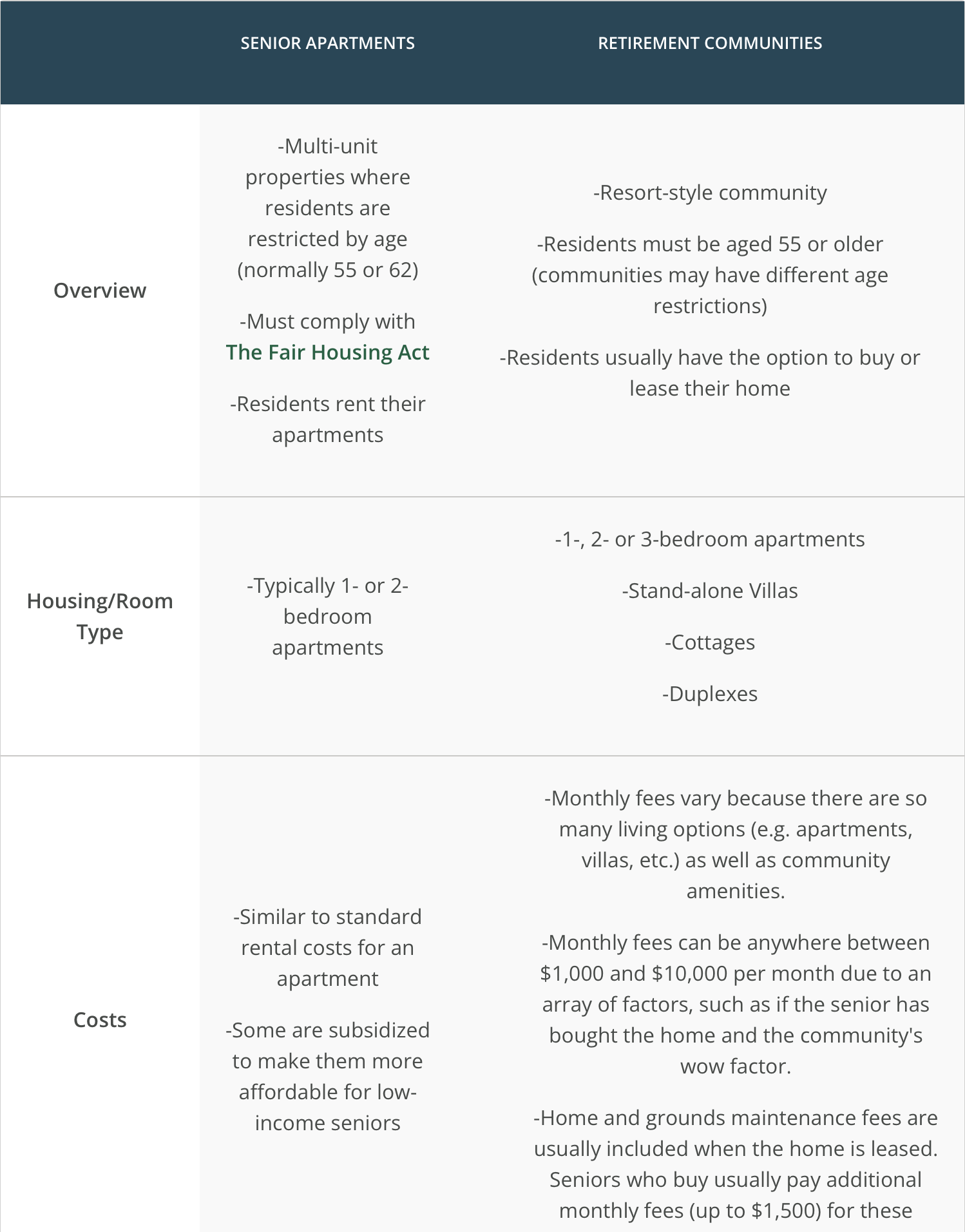
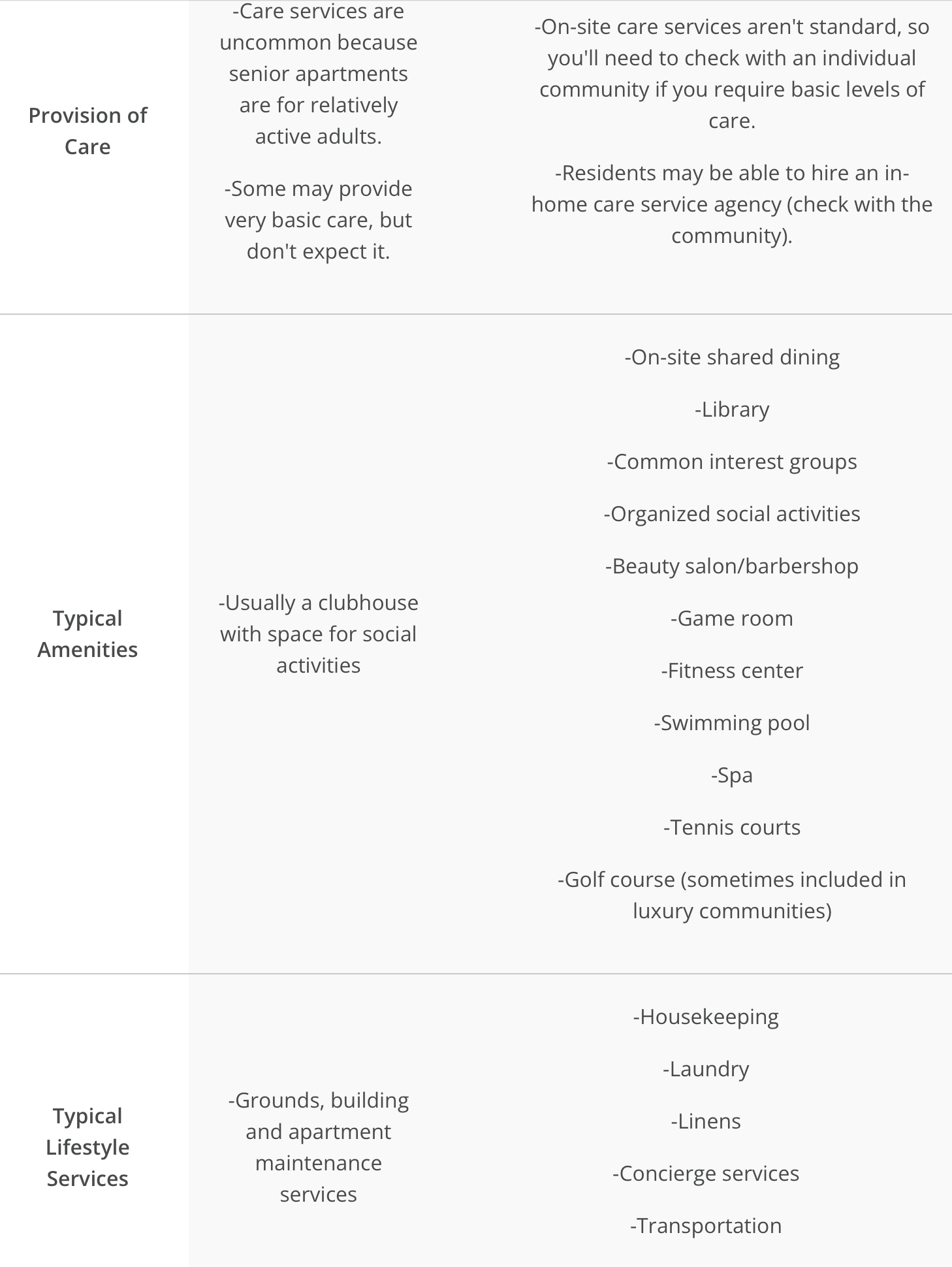
Seniors can age in place in their own homes, but there are two popular alternatives. Often marketed as 55+ communities, senior apartments and retirement communities are similar, but the differences are noticeable. The following table compares both of these options:
What to Look for in a Home for Aging in Place
When you’re looking for a home where you can age in place, whether that be in an all-ages community or a retirement community, there are certain things you should be on the lookout for to help ensure it’s a safe location to age in place. Bring the below printable checklist with you as you tour potential residences to see what safety features for aging in place the home does or does not have.
Working with Professionals to Help You Buy a Home
You may have bought and sold a property before, so you’re probably aware of the benefits of involving professionals to smooth the process and help you avoid potential pitfalls. This may be a real estate agent, broker or insurance agent. You should also consider working with professionals who specialize in helping seniors relocate to new homes and 55+ communities. The following three are possibly the most important.
Senior Home Safety Inspectors
A Senior Home Safety Inspector provides a comprehensive assessment of their client’s existing residence or potential new home. The inspection’s purpose is to discover possible hazards and suggest improvements to make the home more senior-friendly. A typical inspector will look for:
Tripping hazards, such as slippery flooring, floor seams in entryways and loose outdoor paving
Electrical concerns, such as faulty wiring and a lack of smoke and carbon monoxide alarms
Plumbing issues, including baths that may be difficult to use without falling
Door width and ramps if the senior uses a wheelchair
Stairs and railings that may be hazardous due to loose carpeting or shaky banisters
Round doorknobs and faucets the senior struggles with that can be replaced by lever-style alternatives
Senior Real Estate Specialists
A Senior Real Estate Specialist (SRES) is a Realtor recognized by the National Association of Realtors as someone who specializes in helping seniors buy and sell homes. An SRES Realtor can help seniors deal with aspects of buying and selling that are specific to their age group. For example, they can advise on the pros and cons of 55+ communities they have experience with, develop strategies for downsizing and arrange and coordinate essential home repairs and staging.
An SRES-certified Realtor will also have knowledge of estate planning and relationships with local financial planners who specialize in retirement planning. The National Association of Realtors has a comprehensive database of the country’s SRES-certified realtors that seniors can access for free.
Senior Move Managers
A Senior Move Manager is someone who specializes in helping seniors relocate, which includes the emotional and practical challenges of moving. The following list includes some of the services they offer although these can vary depending on the senior’s needs.
Designing an age-in-place plan that may include relocation
Developing a plan to help the senior downsize to a more suitable living space
Arranging the disposal of items the senior won’t need or want in their new home while making sales as profitable for the senior as possible
Arranging the storage and shipment of the senior’s possessions
Organizing professional packing and unpacking services
Services related to moving home, such as finding a Realtor and preparing the home for sale
If someone you know has had a good experience with a Senior Home Manager, you should consider asking them for advice. To find a Senior Home Manager in your area, check out the search tool provided by the National Association of Specialty & Senior Move Managers.
How to Pay for a Home to Age in Place
Ultimately, paying for the home where you want to age in place will likely be your biggest concern. As previously mentioned, you can’t rely on Medicare, Medicaid or long-term care insurance to cover your costs. However, you have options depending on your income, credit score and available cash. The following lists some options.
VA Housing Assistance: Veterans and surviving spouses who satisfy eligibility criteria may be eligible for a VA direct or VA-backed loan to buy their homes.
Supportive Housing for the Elderly Program: This program from HUD helps seniors on very low incomes get the financing they need to purchase homes specifically designed and maintained for older citizens.
Mortgage: The Equal Credit Opportunity Act means a financial institution can’t discriminate based on the applicant’s age. If you can prove a consistent monthly income post-retirement (usually for three years), the institution must seriously consider your application.
Finally, you should get independent financial advice before entering any financial agreement. If you can, find an adviser with experience helping seniors buy homes in retirement communities.
Find a Retirement Community Near You Where You Can Age in Place
If you want to live in a community of other older adults with whom you can socialize, enjoy shared community spaces, and form friendships, a retirement community may be the best option for you to age in place. As opposed to buying a downsized home in a standard all-ages communities, retirement communities offer unique social benefits.
When choosing a retirement community, first decide on a price point and create a checklist of what your ideal facility must have and what you’d like, but are open to compromise on. Consider its location and if it makes it easy to visit surrounding attractions and for loved ones to visit you. Also think of the facility’s ability to satisfy your educational, social and spiritual needs.
Book a visit with each facility that meets your criteria, ideally that coincides with important daily events, such as mealtimes and classes, so you can see how it handles busy periods. If possible, try the food. Ask questions on an array of subjects, such as security, staff training and how the facility deals with emergency situations. Following these suggestions should help you narrow down your choices to one or two facilities, which should make it easier for you to decide and be confident with your decision.
Arkansas is filled with attractions that may appeal to seniors. A multitude of museums and parks are located in this state, including the Mid-America Science Museum and Withrow Springs State Park. Arkansas has a total population of just over three million, and 17% of these residents are aged 65 and older. The population has grown by an estimated 3.5% since 2010, according to U.S. Census data. There’s an AARP state office in Des Moines that provides valuable resources and information for senior citizens.
The average monthly cost of assisted living in Arkansas is $3,175, as reported by the Genworth 2019 Cost of Care Survey. The U.S. average for monthly assisted living costs is $4,051, which makes Arkansas a comparatively affordable place to live for retired seniors.
This guide contains assisted living cost comparisons with other care types and states. There’s also general information about assisted living, along with information regarding assisted living regulations in Arkansas. Financial assistance programs and resources for seniors are also included.
SeniorAdvice’s Guide to Assisted Living in Arkansas
Arkansas has a SeniorScore of 69%, which is only slightly lower than the national average score of 72%. This score is calculated through an analysis of over 100 variables, including finances and health and safety. The data reported by SeniorScore can be used by Arkansas seniors in assisted living who want to compare the benefits and drawbacks of various U.S. locations.
The general quality of life score for Arkansas is 68%. This score is on par with neighboring states such as Louisiana, which also ranks at 68%. Mississippi has a similar general quality of life score at 69%. Arkansas has a mild average annual temperature of 60.3 degrees F, so seniors in assisted living can enjoy ample outdoor activities. The population density is 174 people per square mile, which may appeal to seniors who prefer a less populated locale.
Arkansas has a relatively high sales tax average of 9.24%, which is offset by lower property taxes as compared to the U.S. average. The cost of living in Arkansas is below the national average, which may help seniors in assisted living manage monthly expenses.
The general quality of life score for Arkansas is also affected by the senior population, which is slightly higher than the national average. Fitness and leisure also factor in — the state has 161 golf courses for seniors to enjoy. There are also 1,442 churches in Arkansas, which may appeal to seniors interested in attending devotional services
The Cost of Assisted Living in Arkansas
The monthly assisted living cost in Arkansas is $3,175 per month, which is significantly lower than the national average of $4,051. It’s also less expensive than several neighboring states — Louisiana’s monthly assisted living cost is $3,650 while Mississippi’s is $3,524. Oklahoma has a more expensive assisted living cost than Arkansas at $3,518, as does Tennessee at $3,900.
Arkansas: $3,175
United States: $4,051
Louisiana: $3,650
Mississippi: $3,524
Oklahoma: $3,518
Tennessee: $3,900
The Cost of Assisted Living in Arkansas’ Top Cities
Arkansas assisted living costs vary depending on the city. Little Rock is the most populous, with a monthly assisted living cost of $4,783. Both Fayetteville and Springdale have an estimated assisted living monthly cost of $3,611. Jonesboro’s assisted living cost is $3,200. Although Fort Smith is the second-most-populous city in Arkansas, it has a comparatively low monthly assisted living cost of $2,925.
Little Rock: $4,783
Fort Smith: $2,925
Fayetteville: $3,611
Springdale: $3,611
Jonesboro: $3,200
Senior Cost Comparison in Arkansas
There are five categories of senior care in Arkansas with varying monthly costs. Assisted living is in the middle of the spectrum at $3,175, while adult day care is the most affordable at $1,948. Nursing home care is the most expensive at $5,505, while home health care and adult day care come in at $3,623 each per month.
Assisted Living: $3,175
In-Home Care: $3,623
Home Health Care: $3,623
Adult Day Care: $1,948
Nursing Home Care: $5,505
Financial Assistance for Assisted Living in Arkansas
Medicaid Assisted Living Facilities (ALF) Level II Program
One of the programs available to help seniors handle the costs of assisted living is Arkansas Medicaid Assisted Living Facilities (ALF) Level II program. According to the Arkansas Department of Human Services, a level II facility provides assistance with activities of daily living (ADLs) to individuals who are age 65 or older, blind or physically disabled. Residents of a level II assisted living facility may be eligible for this program, which includes full Medicaid benefits. Although room and board costs are not part of the coverage, the program may still help seniors offset their monthly assisted living costs.
Eligibility for this program depends on income and resource limits. The income limit for the Medicaid ALF waiver is three times the SSI Standard Payment Amount (SPA) at $2,250 per month. The resource limit for this waiver per individual is $2,000. Only the individual applicant’s income and resources are counted for eligibility purposes. Individuals who are over the income limit can establish an Income Trust, which may help them become eligible for Medicaid.
Arkansas Medicaid also has a nursing facilities assistance program for residents in assisted living who require rehabilitation services or skilled nursing care. Seniors who qualify for this program receive complete Medicaid benefits; in addition, Medicaid also covers some or all the monthly facility payment based on the resident’s monthly income.
The financial eligibility for this program is the same as the ALF Level II program. Assisted living resident income cannot exceed $2,250 per month and resources cannot exceed $2,000. As with the ALF program, assisted living residents whose income exceeds the limit may qualify for Medicaid by setting up an Income Trust.
Program of All-Inclusive Care for the Elderly (PACE)
The Arkansas PACE program is designed for seniors aged 55 in assisted living facilities who require primary or preventative care. The medical services provided by PACE are provided at locations called PACE Centers. Although this program doesn’t pay for monthly assisted living costs, it may help seniors more effectively manage assisted living costs by lowering medical costs.
The income limit for the PACE program is $2,250 per month. Resources cannot exceed $2,000 per month. Seniors in assisted living whose income exceeds these limits may still be eligible for Medicaid by establishing an Income Trust. Contact Arkansas Human Services at (855) 207-7500 for information about eligibility and the location of PACE Centers.
Arkansas Assisted Living Rules and Regulations
Assisted living facilities (ALFs) in Arkansas are licensed and regulated by the Arkansas Department of Human Services (DHS), Division of Medical Services, Office of Long-Term Care. These facilities fall into two categories: Level I and Level II. Each type of facility provides assistance with activities of daily living (ADLs) in a homelike residential setting. Each ALF resident must be provided with an independent apartment that includes a kitchen. For more information about ALF regulations and licensing, visit the Office of Long Term Care’s website or call (501) 682-1001.
Scope of Care
Assisted living facilities (ALFs) in Arkansas provide assistance with activities of daily living (ADLs) for four or more residents. This may include bathing, toileting and mobility assistance, among other services. Care is provided by on-site staff on a 24-hour basis.
Care Plan Requirements
Upon admission, a needs assessment must be performed for every resident to determine what kind of care plan is required. Reassessment is required annually, or whenever there are changes in the resident’s care needs. Before admission or on the day of, the resident and ALF must complete an occupancy admission agreement that defines the core services that are to be provided. Other information including medication and financial policies are also part of this agreement.
Medication Management Requirements
Residents of Level I ALFs must be able to self-administer medication. Staff may assist by taking medication from the storage area and handing the container to the resident. Staff is not permitted to administer medication to residents. Level II ALFs can administer medication to residents who are unable and must have a pharmacist available for consultations.
Staff Requirements
Assisted living facilities in Arkansas are required to have a full-time certified administrator on-site during regular business hours. If the administrator leaves the premises during this time they must delegate facility management authority to a qualified staff member. The minimum number of required direct care staff varies according to the number of residents and time of day. There must be staff on-site 24 hours a day, 7 days a week.
Staff Training Requirements
Upon hire, all staff members must receive orientation on facility policies, along with information about resident rights and reporting senior abuse. Staff must also be trained in fire and safety procedures. Facilities that administer medication to residents must provide annual training. In addition, all personnel of Arkansas assisted living facilities must complete 6 hours per year of ongoing education.
Medicaid Coverage
Arkansas Medicaid covers assisted living personal care services for facilities licensed as level II ALFs. In order to qualify for coverage, seniors must meet income and resource limit requirements. The income limit for eligibility is $2,250 per month, while the resource limit is $2,000 per month.
Reporting Abuse
Incidents or suspicion of elder abuse should be reported to the Arkansas Department of Human Services Adult Maltreatment Hotline at (800) 482-8049.
The Division of Aging, Adult & Behavioral Health Services is part of the Arkansas Department of Human Services. Seniors age 65 and older may be eligible for the programs and resources provided by this department. Aging and Adult Services helps support the physical and mental well-being and safety of senior Arkansas residents.
Contact: Call (501) 682-1001 during normal business hours to find out more about the resources available.
The Arkansas Long-Term Care Ombudsman Program advocates for seniors in assisted living facilities. The office provides valuable resources for residents, families, facility staff and the community. In addition, it advocates for seniors’ quality of life. Investigation and resolution of assisted living resident complaints is also handled by the Ombudsman office.
Contact: Call (501) 508-8857 for more information about Ombudsman services and for a referral to the appropriate county office.
Arkansas Agencies
Area Agencies on Aging in Arkansas
Arkansas has eight Area Agencies on Aging (AAA), which operate under the Arkansas Department of Human Services. These agencies refer seniors in assisted living to programs that may include transportation assistance, meals-on-wheels programs and other resources that promote a positive quality of life. Some programs may even include financial counseling or other finance-related resources to help seniors effectively manage assisted living costs.
The AAA has a webpage where seniors can find their local agency. Visit the AAA website, or call the Arkansas Department of Human Services at (501) 682-1001 for more information.
Veterans Affairs Offices in Arkansas
The Arkansas Department of Veterans Affairs (ADVA) oversees multiple Veterans Affairs (VA) offices around the state. These offices are responsible for dispersing pension benefits to veterans of all ages, including retired seniors. Also offered by the VA are employment services, which may help seniors on a budget pay for the monthly costs of assisted living. Mental health services, food services and other resources may also be available from the VA. The ADVA website can direct seniors to their local VA office; they can also call (501) 683-2382 for information about benefits and resources or to file a claim.
Social Security Offices in Arkansas
There are numerous Social Security offices in Arkansas. The SSA provides Supplemental Security Income (SSI) to seniors age 65 and older. This income can be used to pay for assisted living costs. Seniors may also find information about applying for Medicaid through their SSA office, in addition to other programs and services that may be of assistance. Seniors can find the nearest Social Security office to them on the website. In addition, seniors can apply for SSI benefits on the site or by calling (800) 772-1213.
If you are considering selling your home, there are several things you can do now to make the best first impression on potential buyers. Taking the time to declutter, deep clean and make simple repairs will show buyers that your house and property are well-maintained and ready for a new owner.
Increase Curb Appeal
A clean and attractive exterior is crucial, as it creates a positive first impression and sets the tone for the rest of your home. Spruce up your outdoor space by removing overhanging tree limbs and branches, applying a fresh coat of exterior paint, mowing the lawn, adding plants or flowerpots, power washing, painting patio and deck areas and repairing or replacing damaged screens and doors.
Take Care of the Obvious
While grooming your outside space, you’ll need to address any glaring concerns. Check and fix loose or damaged roof shingles, bricks, wood and trim. Clean out septic systems to ensure your property is in top working condition. With these projects completed, you’ll also reduce maintenance stress while your home is listed.
Make the Interior Shine
Create an inviting and welcoming atmosphere by cleaning, decluttering and organizing your home, which shows buyers that there’s plenty of space. Freshen up your indoor areas by painting walls, removing outdated rugs or furniture, polishing kitchen appliances and deep cleaning hardwood floors, sinks, tiles and showers.
Remove the Clutter
You’ll also want to check that any clutter is cleared by organizing closets with shelves and storage bins, storing everyday items like paper and toys in cabinets and closets, and removing personal items like picture frames and your kid’s tee-ball trophies. While you’re thoughtfully arranging, you could take advantage of this opportunity to get rid of any paperwork that is no longer needed while gathering documents potential buyers may need to review in in a handy folder. These papers could include HOA information, appliance manuals, warranty information, records of repairs (especially if it involved electrical, plumbing or contractor issues) and the survey of your property.
By increasing the outdoor appeal, creating a warm, appealing indoor space and gathering all the information upfront before listing your home for sale, you’ll be well on your way to smooth, stress-free transaction – and seal the deal with a great first impression.
Prevent toasting to your home from a plastic cup by saving your delicate wine glasses with these packing techniques of the correct way to pack wine glasses for a move!
If you are one of the lucky folks on the move this month, you are probably up to your knees in boxes and packing paper. You’re trying to figure out how to pack everything so it ends up in one piece in your new home. Well, let us help you with one of the most difficult items to pack: wine glasses. Because of their odd shape they are often packed incorrectly and their delicate glass and long stems get broken in the moving process.
We have seen too many new homeowners sipping out of plastic cups after a move. Let the plastic frat house red cups be gone! Let’s put some elegance into that new home from the start. Here’s a simple step-by-step guide on how to properly pack wine glasses to keep them in one piece and easily accessible after move day —
Select the Proper Box:
One of the key factors to keeping your wine glasses from breaking or getting crushed is using the proper box. You need a box that is big enough and secure enough for your glasses. We recommend a “dishpack” box because it’s 5.2 cubic feet high and has double thick walls for extra protection.
Gather the Right Materials:
Once you have the proper box, gather the packing materials to wrap and protect the glasses. Here is what you will need:
Packing Paper (Lot’s of it. And, get the plain recyclable packing paper, not newspaper so you don’t have to spend time washing newsprint off all your stemware.)
Cardboard Inserts (If you are unable to get these inserts, we will teach you how to do without them)
Wrap:
Place a wine glass on packing paper horizontally. Grab a corner of the packing paper and roll the glass into the paper. Make sure to tuck the sides of the paper in, like you would do wrapping a burrito. Continue rolling the glass on the paper until you reach the end of the paper. Place the now wrapped glass back on another piece of packing paper horizontally and roll again. Repeat 3-5 times (depending on thickness of glass) with more sheets of packing paper until the glass is properly secured & cushioned. Continue for each wine glass. Label the outside of your “burrito” package: “glass” so it won’t get tossed out with the extra packing paper.
Pack & Pad:
Before placing any of the wrapped wine glasses in the box, cushion the bottom of box with packing paper. If you are using the cardboard inserts, position one layer of the inserts in the box on top of the packing paper and place one wrapped glass into each cardboard insert. If you are not using the cardboard inserts, place the wrapped glasses vertically in one layer in the box. Make sure to place them standing up and not lying flat. They are more secure vertically.
Layer & Repeat:
After completing the first layer, place packing paper on top. Add more inserts or place wrapped glasses vertically. Repeat these layers until the box is full.
Stuff Empty Space:
Once the box is full, fill any remaining space with crumpled packing paper. The layer of crumpled paper will add extra cushion and security for the glasses.
Tape & Move:
Lastly, securely tape the box closed and leave it for the movers to carefully move it to your new place! Be sure to label each side of the box “FRAGILE Wine glasses” and arrows pointing up on all sides of the box. Also, write the name of the room you want the box to end up in your new home: “kitchen” or “dining room.”
We hope the techniques of the correct way to pack wine glasses for move help!
Navigating Life’s Major Transitions: Exploring Family Changes and Downsizing as Motivators for Moving
For many, life holds various pivotal moments that can prompt individuals and families to consider moving to a new location. Whether it’s adapting to changing family dynamics or embracing a downsized lifestyle, these major life changes often act as catalysts for relocation. So what are the factors that drive people to move? By understanding life’s major motivators for moving, you’ll gain valuable insights into the emotional, logistical, and practical aspects of moving during transformative times.
Embracing New Family Dynamics: Relocating for Family Changes
Family dynamics naturally evolve over time. Consequently, this leads to various circumstances that necessitate a move. Here are some common family changes that prompt individuals and families to consider relocation:
The New and Growing Family
Welcoming a new addition to the family often brings about the need for a larger living space. Perhaps you need to think about proximity to schools and amenities, and a supportive community. Moving to a family-friendly neighborhood with suitable infrastructure becomes a top priority for expectant parents.
Empty Nest Syndrome:
Of course, as children grow up and leave home, parents may find themselves with a significantly larger house than they need. Downsizing to a smaller home or relocating to a different neighborhood or city can provide an opportunity to downsize and better align with their new lifestyle.
Blended Families:
Marriages or partnerships that result in blended families can lead to the need for a new home that accommodates the expanded family structure. A move may be necessary to ensure everyone has enough space and to establish a harmonious living environment for all family members.
Transitioning to a Downsized Lifestyle: Relocating for Simplicity and Efficiency
In an era where minimalism and simplicity are increasingly embraced, downsizing has become a popular choice for many. Here are three key reasons why people choose to downsize and move:
Financial Considerations:
For some individuals or families, downsizing is a strategic move to improve financial well-being. Moving to a smaller, more affordable home can free up resources for savings, investments, or pursuing other life goals. Moreover, downsizing often leads to reduced utility costs and maintenance expenses, easing financial burdens.
Lifestyle Simplification:
Downsizing provides an opportunity to declutter, reduce possessions, and create a more streamlined living environment. Smaller spaces necessitate a conscious curation of belongings, allowing individuals to focus on what truly matters and eliminate unnecessary stress associated with maintaining a larger home. The allure of a simpler lifestyle can inspire individuals to seek out new, downsized living arrangements.
Empty Nesting and Retirement:
When children leave home or retirement approaches, the need for a large house diminishes. Empty nesters and retirees often opt to downsize to a more manageable and maintenance-free property. This transition allows them to unlock newfound freedom, pursue their passions, and explore new adventures without the encumbrances of a larger home.
Conclusion:
Moving is a significant decision that often arises during major life changes. Many experience shifts in family dynamics and the desire to embrace a downsized lifestyle. By understanding the motivations behind these transitions, individuals and families can better navigate the challenges and opportunities that come with moving. You may be accommodating new family members, simplifying life, or optimizing finances. The decision to relocate can pave the way for a fresh start and a brighter future.


 Facebook
 X
X
 Pinterest
 Copy Link